The Design of Childhood

I am writing this in bed with a cozy blanket and a dog at my feet. Rain is just starting and I can hear it rustling the leaves outside my window. I am awake (again) so early in the morning because I am filled with excited anticipation. In just a few hours, fifteen kids will enter my classroom for the first time. I spent hours yesterday unloading, unpacking and moving back in all the comfy chairs, pillows, beanbags and loveseat, bringing my classroom back to its pre-pandemic set-up. The process brought me unspeakable joy. Gone are the rows of desks, set six feet apart, where my kids sat all day every day this past year. Gone is the teacher’s chair where I spent more time than I ever have, strapped to a specific spot in the room in order to present where all could see. Gone are the individual sets of supplies and materials. I welcomed back all the choice, flexibility and comfort that makes my classroom a true reflection of what I think good education should look and feel like.

The summer learning program my district is implementing is based on an outdoor education model. I could not possibly be more excited. After years, especially this last one, focused on making significant academic progress with students – of “catching up” all.the.time – of a focus on completion and percentages and compliance, this summer is all about fascination and discovery. It’s not that we don’t want the students to learn this summer, obviously, it’s that we want them to love to learn. The whole design reminds me of my childhood.
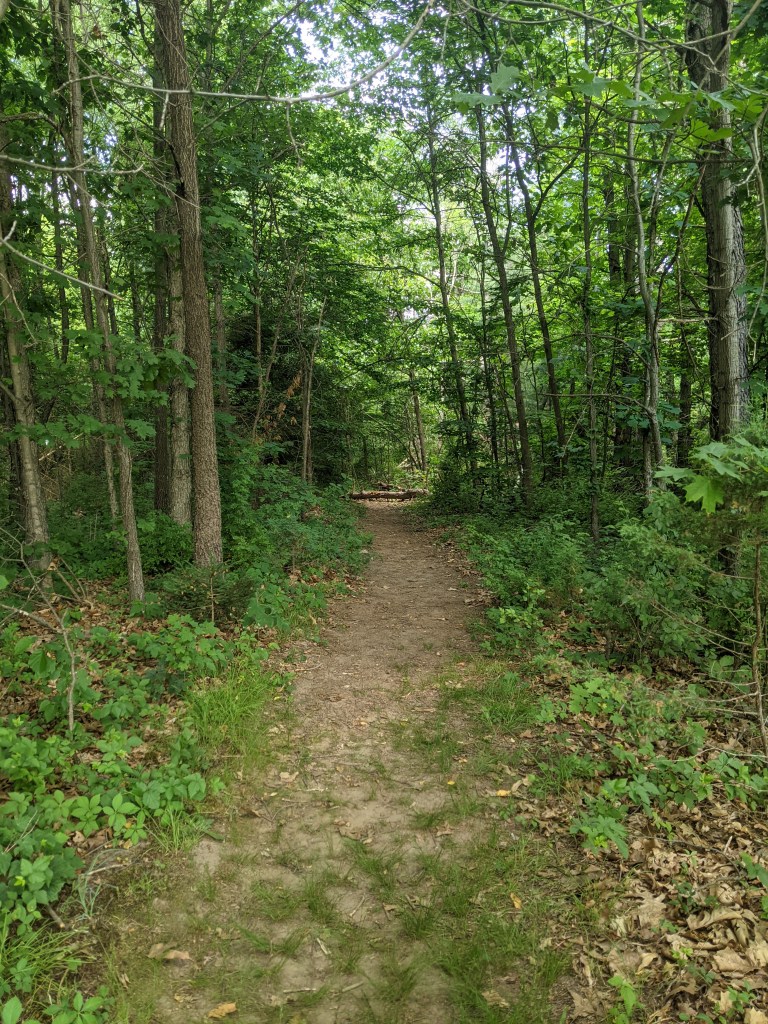
I spent years as a child, playing in the woods behind my house. With little more than my imagination (maybe a shovel, maybe some rope), I would spend hours walking trails, making forts, exploring the creek, getting dirty and getting involved in nature. I also spent hours curled up on a couch or in my room reading books. I spent hours writing stories, songs, poems, plays – anything that I could dream up, I would write down. I spent time with friends and while I thought we were just playing together, I was learning how to compromise, how to empathize and how to work together towards a goal. My family went camping and we spent time playing Yahtzee during rainstorms and Uno around a campfire. We ate simple meals that we all helped prepare and we spent hours traveling in a car without video games or movies to keep us entertained. In short, my childhood was spent experiencing the world around me. While my parents might have thought a camper meant “cheaper vacations for a family of five,” it gave me the opportunity to see new sights, new people, new activities, new adventures. I learned so much from these experiences.

As adults, I remember my sister and I reflecting on something one of our children did, that he or she “just had to learn it the hard way”, implying that our kids couldn’t just take our word for something, they had to actually make the mistakes on their own to actually understand what we had been saying all along. We said this disparagingly. We said it as though our own children were less than smart for not modifying their own behavior based upon something wise we once shared with them. How foolish of us as parents! Children need to learn by doing. And doing means making mistakes. Often. To quote Ms. Frizzle of The Magic School Bus fame, “Get dirty! Take chances! Make mistakes!” Allowing students to experience life and then to mold learning around that experience is truly what lifelong learning is all about. And to experience life, you must get out there and be a part of the world.

I want my classroom to feel like my childhood. To feel open to possibilities and exploration. To feel available to all students every day no matter what mood they arrived in or what activities will come their way throughout the day. I want kids to feel like learning should be fun, but that it takes personal involvement. It isn’t a spectator sport from the second seat in the third row. Giving my students a choice of where to sit not only allows them the freedom to choose what is most comfortable – a chair, a twisty bucket seat, a couch, a pillow to lean on – it also gives them the opportunity to learn self-control, focus, attention and how to limit distractions. It teaches compromise, compassion and the joy of sharing. Just as I prefer to read and write in a comfortable, warm, cozy spot, I want my students to have the flexibility to learn from a place that is the most comfortable while being the most involved and productive as well.

These fifteen kids might not be lying awake in eager anticipation of summer school this morning as I am, but I hope that tomorrow or next week they are so eager to come experience learning that they are up early and bubbling with enthusiasm. And I hope that when they return full-time to school in the fall, that they will be just as eager, just as enthusiastic, just as involved in their learning. This is what learning should look and feel like. Childhood should be about exploring our world and learning how to navigate ourselves appropriately within it, in school and outside of it. It should be full of opportunities to try something new, to fail more often than succeed, but to also experience the joy of accomplishment that comes from hard work. I can’t wait to experience it with them.
Doing The Work

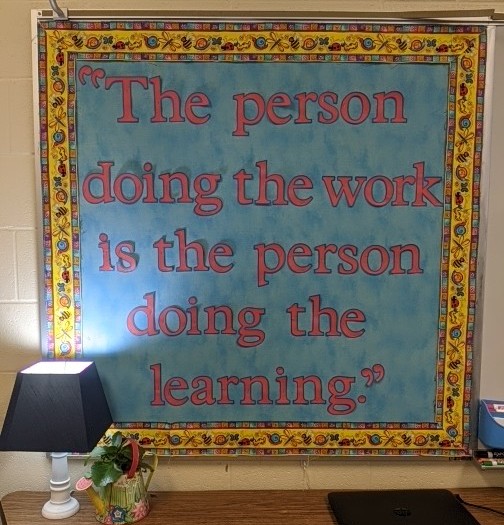
For nearly five years, this bulletin board has been in the front of my classroom. I put up what I believed to be the unsourced quotation as more of a reminder to myself than my students, but certainly to encourage them to actively participate in the learning process and not just be a bystander to it.

The first couple of years I referred to the quotation often in class. I would model working through a problem or a text and then I would remind students this was what learning looked, felt and sounded like and I would encourage them to do similar work to promote their own learning.

This past week, I was reading further into Ken O’Connell’s book, How to Grade for Learning, when I stumbled upon this same quote, attributed to Terry Doyle. In this context, however, the emphasis was on involving students in the work of using specified and cooperatively-determined criteria to self-assess and to help each other to assess their work. All these years, I had been trying to involve students in the work involved with learning tasks, but not in the whole process of learning, including the metacognitive practices of self-reflecting on learning.

I have struggled for years to make the self- and peer-revision process meaningful to my students, but it never turned out to be much more than a weak exchange of trite and vague compliments. “I really like your story.” “You did a good job with the characters.” If I involve students in the actual work of providing feedback – if I explicitly teach them how to use the predetermined criteria that we developed together to guide their responses to their own work as well as that of others, I can surely take their work and therefore their learning to an entirely new level. In addition, while it is hard for a student to diminish the impact of teacher feedback, putting my words alongside their own and those of their peers further adds to the bank of encouragement and support as well as providing multiple perspectives on ways to grow and improve.

While the end of the year often prompts ideas for changes and improvements in my classroom and instruction, this bulletin board will surely remain, but with new perspective and emphasis. The one doing the work is certainly the one doing the learning,” but moving beyond just completing assignments and practice work, teaching and including my students in the work of providing meaningful feedback is a life skill I am happy to promote!

Selling Myself Short

In the wee hours of this morning, I am awake, suffering from 20/20 Articulation-Induced Insomnia. We’ve all suffered from it at one time or another; the painful restlessness that comes when our mind is compiling concise, direct-but-personable, well-stated responses to questions hours or even days after an actual moment when we fumbled, rambled and spoke like a four-year old with an audience. I can be very articulate. In hindsight.

I interviewed yesterday afternoon, for the first time in probably twenty years. That’s not entirely true. I’ve switched careers within the past twenty years, but each time I interviewed for a teaching position, I was a known entity by my potential employer and the “interview” was little more than kicking the tires and making the process seem impartial. Today I interviewed for a new position, outside of my current district, with people who know my name and a few minor details, but not with any assuredness that I was a shoo-in for the job. In fact, after today, I feel like I am anything but.

I should be able, on a good or a bad day to state in no uncertain terms the value that I bring to my classroom, my school, my district, my world. And while the pandemic has certainly made it more challenging, (How do you share recent examples of how you’ve implemented a literacy strategy in your classroom when, despite reading and writing being your life passions, despite all your degrees and training being literacy based, this year you’ve only taught math because you took one for the team and so it’s been over 15 months since you last taught anything ELA related?) But even in spite of darn COVID and all the ways it has changed instruction this year, I should still be able to state clearly the practices and methods I have used with success before. So perhaps the problem is a deeper one – perhaps the problem is that I don’t feel value in what I do. And I think this is where the rubber hits the road for me. This is why I was interviewing in the first place. It is not that I don’t feel “liked” by my colleagues or administrators. It’s not that I don’t enjoy the people I work with or the place where I spend my days. It’s that I don’t know what unique value I bring to the classroom anymore. Teaching has its moments of sweet assurance and gratitude. Students from time to time will write a cute note reminding me that I’ve done something to make them feel loved and appreciated. Every great now and then a parent might even do the same. There’s an entire week in May devoted to making sure teachers feel appreciated. But day in and day out, it is a thankless, demanding, exhausting job with far more moments of criticism than praise and more often than not, the message from a parent isn’t a kind one of gratitude but a less than sympathetic rant about all the ways I’ve wronged a child.

These negative messages from parents aren’t the only ones we are receiving. I think we have been told, in passive and repeated ways from each other and from administrators and district leaders that our opinions aren’t worth much, and our experience counts for even less. I graduated with a four-point in my major in college. It has never once mattered that I studied that hard, or took all my classes and internships super-seriously. I graduated with a four-point in my Masters program as well, in more recent years. I have never once used a morsel of information from my Masters program in my profession. My opinion has never carried any more weight to it because of the hours, months and years I spent pouring over research, analyzing processes, learning and applying new instructional methods during my Masters studies. I work with people who have Masters in various educational specialties but we never refer to each other as more of an expert in “literacy” or “technology” or even “leadership” because of any of that. When we, as a district have things to learn, an outside “expert” is brought in. Many times, these people have no more credentials or experience than we have within our own current staff.

Additionally, the push by those who can, for all teachers to teach exactly the same thing from the same text using the same practices and methods has quieted my voice of experience. When the “curriculum” is what matters (if only because of the huge price tag the district keeps reminding us about) then what is it that I bring to the table of value except the ability to turn the page in the TE and read from the published materials? (Certainly not all administrators push this agenda, but even those who mean to encourage and support me often leave me with little more than an “Atta Girl!” with no specific, meaningful feedback that I can internalize, take value from and grow out of.)

Perhaps it’s no wonder, then, that I was inarticulate when it came to selling myself yesterday afternoon. But this only fuels my desire for change. This adds momentum to my desire to do more beyond or within the environment I am in. The position I was interviewing for was an opportunity for me to help support teachers, in much the way that I’ve supported students over the years – to guide and encourage, to provide supports, ideas and instructional techniques to help each teacher move his/her practice forward in a very positive way. A path that not only generates the obvious goal of student achievement but also cultivates self-worth and empowerment for teachers. A win for all.

Perhaps this position was the exact right one for me and my inability to answer interview questions with brevity and precision will not keep me from being hired. Perhaps. Perhaps this position is not where I need to be – yet. Perhaps I still have learning to do within my classroom. Regardless of what my official job title is today, tomorrow or in the fall, I hope to find ways to lift up my fellow colleagues (and students!); to remind each other of our worth and our expertise and to help empower those around me to use their experiences, their wisdom, their voices to make positive changes in our school. Teachers know how valuable teachers are. And it’s time we help each other to stop selling ourselves short; to not only know we are appreciated, but to deeply feel our worth.

I Can’t Help You With That

Even as I said the words, I felt my entire self cringe. The look on the student’s face mirrored my own deflation and I immediately wanted to recant my words. But I didn’t. This was for a grade. All the students had to do it. If I provided help, how would this task demonstrate his abilities? If he didn’t do it on his own what would I put down for his grade?

It’s been three days and the moment still haunts me. I feel the judgment of a thousand online educators, bloggers and professionals in the field. I hear the voices in my head telling me what a horrible teacher I was in that moment and how could I not know better? But the truth is, I don’t know what to do in that situation. We have certain assignments and assessments we have agreed on as a grade level to “take for a grade”. This was one of them. While every ounce of my being tells me this was obviously not the way to help this student and that I know I did far more damage by the exchange than the grade could ever be worth, it isn’t a singular incident. How many times when my students are taking a test do I see a student struggle and I yet offer no assistance? How many times have I clearly seen a student completely lost during instruction but I just keep plowing through the material as if getting to the end of the teacher’s edition by the end of the year is what really matters?

I admit these things out loud because I know I am far from the only one doing them, or feeling shame about them.

Next week I am eagerly participating in a book study on, How to Grade for Learning by Ken O’Connor. For once, a professional development offering feels like perfect timing for me. It is exactly the help I need at exactly the time I am most open and receptible to it. As my district prepares to make the switch to standards-based grading, this book study is our introduction to the ideas and practices that will help us use grading in a way that facilitates learning – the exact thing my grading of that particular assignment did not.

The student turned in his paper and had actually figured out the problem on his own. When I returned his paper to him later, I told him that I had reacted poorly and that I wish I had not said I could not help him. I used the moment to show him that I am still a learner myself and that mistakes are something we all do, and that we must all own those errors and try our best to improve upon them. I asked if he had any further questions about the problem and he explained where he had gotten stuck and how he had resolved the issue. I assured him that I would eagerly help the next time he asked and that I hoped he wouldn’t take my poor response this time as an indication that he shouldn’t ask for help again.

And while he assured me he understood and promised he would ask, I know that I cannot erase my words from his mind or change the way it made him feel in that moment. I know that I will never forget the sting I saw on his face. It will serve as a precious reminder of what not to do. With Mr. O’Connor’s book as an introduction and guide, I look forward to finding ways to improve my grading practices so that these incidents never happen again. For both of our sakes.

I Know This Because

It took until April, but it finally happened. A student in class volunteered to answer a question and when I called on her, she not only gave her answer but added, “I know that because…” at the end of her response. I praised her for including her reasons with her response and internally beamed at hearing a student respond in such a way without my prompting.

All year, when a student answers a question right or wrong, I tend to follow his/her response with, “How do you know?” encouraging the kids to justify their answers. I’ve found this method helps kids to not only think through their response, but also to articulate a justification, which can often be more difficult than knowing the answer in the first place.

I was reading an article posted by Jennifer Gonzalez yesterday on cultofpedagogy.com. The article referred me to a blog by Colin Seale on Mistake Analysis. The article really resonated with me as I try to continually navigate ways to improve student thinking and conversations. I am a fourth grade teacher providing only math instruction to our school this year, but I believe my job as an educator is to help create involved citizens of our world. To me, this means helping these ten year olds start to learn how to disagree with kindness; how to explain their own beliefs and ideas in an open, honest way that promotes dialogue not division. I don’t believe I am preparing my students to eventually exist in our world, I believe they already do and that these skills are not just desirable, they are necessary if we are to unite as people.

In Colin’s article on Mistake Analysis, he reminds me of more methods for teaching and encouraging students to use these verbal and critical thinking skills. I was particularly struck by his suggestion to help students see which answer is “more right” than which answer is necessarily just plain wrong. As Colin states, “Asking which wrong is more “right” helps learners shift from asking “what” and “how to” to asking “why” and “what if” – a necessary shift for giving students the tools to not just analyze the world as it is, but imagine it as it ought to be.”

As I continue to grow as an educator, I hope to continue to find ways to model how to respond with my opinion or ideas in ways that promote dialogue, community and discussion. I hope to provide extensive opportunities for students to practice these methods and to begin to internalize their worth. As much as it lit me up to hear a student provide rationale to a math answer, I know I have much more work to be done to have a student find joy in working through a mistake; to value the experience of learning through error.

Mistake Analysis isn’t just a valuable tool to help my students, but it’s also a valuable tool to help myself. When I can think critically about a lesson, a conversation with a student or an incident – when I can truly process my contribution in an objective light, I may learn from my own errors and find value in that growth process.

May we all encounter mistakes today that help us grow.

Grace

It’s Thursday after dinner and my phone pings to let me know I have an email. Without pause, I click to read the incoming message even though it’s my school account and by all means could wait until morning. And that’s when it happens. The opening line, “My son came home crying from school today…” goes on to tell me what I’ve done to cause this student such pain that he never wants to return to school. In truth, these incidents are always minor and always an unintentional slight, but to a parent with a child in tears, the feelings are serious and demand attention right now.

These messages occur just often enough that the sting never really goes away and the fear of upsetting another parent hovers over me throughout my days in the classroom. Despite all the effort I put into teaching, there will always be an upset parent who will email me (or worse yet, my principal) to let me know of something I’ve done wrong. The last time it happened, it was during conferences and due to our departmentalized teaching structure this year, my entire team of colleagues got to hear all about my latest transgression directly from a parent during group conferences.

I don’t know many people who take criticism well, but I always feel blindsided by it and it really knocks me down. Profound words of wisdom say, “Don’t take it personally” but it is personal and it was aimed right at me, and so I don’t know any other way to take it.

This last time, I thought about a conversation I had years ago with a former administrator. She shared with me that, most of the time, people just want to feel heard. That truly listening and letting them vent can often take stressful, tension-filled situations down several notches and then a healthy, more open-minded conversation can truly begin. Taking these words to heart, I decided to try putting them into practice.

The first thing I did was nothing. Absolutely nothing. I took time before responding at all and this was a critical change for me. My initial response is often defensive and it isn’t productive to speak from a place of fear, anxiety or compensation. I want to speak from truth and that takes time to reach. I took time to breathe, to think, and to reflect. After pausing for a short while, I recognized my anxiety and defensiveness about this particular situation wasn’t going away in the next hour. I took a breath and sent off a brief, calm, reply thanking the parent for bringing the situation to my attention and promising to give it my full reflection. I thought about an appropriate and proportionate amount of time to give myself and told the parent I would get back to them by the end of the next day. Even though I wasn’t feeling very magnanimous at that moment, even though I felt that this parent was way out of line for emailing me (and copying my principal on it!) about something that seemed quite petty, I chose to compose the email while exhaling and crafted a calm, open-minded, if currently faked, response. Even though I had to use imagined kindness in my initial response because my defenses already had my blood boiling, I wanted to convey involvement and interest in reconciliation.

Having bought myself a little more time, I was now faced with the task of self-reflection. I’ve often skipped this step in my response to criticism. I go straight to Defensive Island and I never leave it. I build a fortress that makes sure that only those agreeing with me and supporting my side can enter. But the truth is, more often than not, what I have needed most is to see the other viewpoint with more clarity.

The process reminds me of the skycam used during televised professional football games. Upon replay, the announcers in the booth can stop the action at a critical point and swing the footage all the way around the incident to see all sides. It’s amazing what changes from this perspective. An apparent fumble can now be seen as an amazing catch given the right camera angle.

So it is with conflict. Given time and an open-mind, I was able to look at the situation from different angles. I stopped thinking about what happened from my shoes standing at the front of the classroom and instead, took a moment to figuratively sit at the student’s desk and think about what occurred. I thought about what I would have heard, seen and felt during that moment. Even after some time, I still didn’t think that what I had said was worth a chiding email, especially one shared with my principal, but I was able to imagine this student in a different light and I understood that the unintentional effects of what I had said included hurting a student. Unintended, sure, but still real pain.

Before the end of the next day, I phoned the parent. I could not have spoken calmly or respectfully the night before after reading the scathing email, but now I was able to listen once again to the concern of the parent and to then respond with compassion and understanding. While I explained my perspective I also, more importantly, owned the response of the student. I let the parent know that I not only heard what was being shared but that I felt the pain and that pain was something I would work to remedy in any way that I could. As all good apologies should, I included not only my words of remorse, but also my plan for reparations and for growth.

The call ended with the parent saying, “You’ve been such a great teacher for him all year, I’m glad we could work through this together. I will talk with him about what you said and help him see that you weren’t trying to hurt his feelings, but that you were trying to help him.”

I hung up the phone and exhaled and realized I was in a moment of grace. Criticism is part of my job. With nearly 60 students to teach this year, I touch a lot of lives each day. I’m human and fallible and even on my best days I can say and do things that are taken differently than intended. I need to remember to not only extend grace to the family – to give them the time, reflection and response that they are due, but also to extend grace to myself. To remember that my perspective from the front of the room is not the only one that matters. No matter how absurd the complaint, taking the time, using the “skycam” to gain perspective, and by rooting all that I do in kindness a harsh criticism can be a growing point for everyone. Especially me.

Authentically Learning

Authentically Learning.  Learning Authentically.  I have literally gone back and forth trying to decide the best title for this post.  I finally realize the answer is obvious.  It has to be authentic before we can really learn.  The things in life that are relevant to us, connected in some ways to the things we hold near and dear, the things with impact that move us, change us, force growth, those are the things that are naturally engaging, natural draws for our focus and attention.  These are the things we remember forever.

I, for the life of me, cannot remember dates.  Don’t ask me when WWI occurred.  Don’t ask me who was president during that time.  Historical figures, wars, political engagements and their significance, it’s in and right back out of my brain.  Even though I’ve taken classes.  Even though I read and listen and pay attention to the news and the world in general, these topics are just lost on me.  I can and have memorized some of this information for academic purposes.  But I never learned it.   Never in the sense that it changed who I am, impacted my future, or was applicable to my daily life in a meaningful way.  It would be safer to say I know of the Bay of Pigs Invasion than I learned it.  It didn’t stick. 

But as an educator, I want more than just learning of or about something for my students.  I want to go much deeper than rote memorization.  I want my students to engage in academic pursuits that are life-changing.  I want them to learn and know, feel, move, act, speak, write, create… I want the classroom to prompt movement or growth in their lives.  

Ambitious for a fourth grade teacher, you might say,  but no.  I think it’s what every educator should be striving for.  But even as I write that, I think back on my days in my high school history classes.  I hated history class.  Loathed might be more accurate.  And even now, I’m hard pressed to see how knowing about that Bay of Pigs Invasion did my life any good.  But what if my teacher had been able to help me connect historical events such as that to my life in a more meaningful way?  What if she had been able to recognize that the Bay of Pigs on its own didn’t carry any meaning for me?  What if she had been able to provide explorations into historical events that allowed me to pursue the knowledge from a different angle?  What if I had been encouraged to look at the human impact from a non-political vantage point?  Might I have not only retained the information longer, but also connected the event to my own life in a way that stimulated personal growth?  Or maybe helped me to understand that it wasn’t really about the Bay of Pigs at all, but it was about the process of exploring such events, the weighing of viewpoints, the research, the human implications – maybe if I had seen the process of learning as being important, rather than the specific topic, maybe it would be a fonder and clearer memory.

So this is my pursuit.  To find ways – big and small – to make my teaching, my classroom, my school more authentic for students.  I want learning to be relevant, connected and impactful.  I want the experience of learning within the walls of my classroom to transcend the room, transcend the building, transcend fourth grade.  I want to develop in these ten-year old kids a lifelong desire for knowledge.  About whatever their individual passions are.  I want them to enjoy the process of learning, of changing, of growing.  And in so doing, I already see the ways it makes teaching more authentic for me.  When I bring relevance, when I can connect learning and events and texts and people, the impact and engagement comes naturally for my students and for myself.  

Even as I write this, I feel pressure.  I hear the buzz words begin to swirl and overwhelm me.  Project-based learning, portfolios, simulation based learning… sigh.  There’s seminars, webinars, books, programs, blogs… But I’m reminded.  Relevant.  Connected.  Impactful.  I am a fourth grade teacher in Southwest Michigan.  I don’t have to dive into the deep end; I don’t have to take on a massive overhaul of my district’s curriculum choices; I can make small changes to what I already do.  The last thing I need as a teacher is more pressure.  What I need is joy.  So I need to make the process relevant, connected and impactful for me as well.  If I make a tweak here, a change there, a minor adjustment to this or an alteration to that, if I take even the smallest of steps, I am still moving forward.  If I am to create learning environments that are authentic, I have to be authentic myself.  Small steps are what I can do.  After all, authentic learning is a process, not a destination.  For all of us.

Relevant.  Connected.  Impactful.  

This is my journey.  Join me.

3am

It’s when they come to me. The moments of doubt, of regret, enthusiasm or clarity. It’s when my mind races to what I should’ve done, should’ve said; when I should’ve kept quiet or when I should’ve spoken up. The thoughts are relentless and I’ve learned over the years that there is no going back to sleep for me.

My phone becomes my savior in these hours. It might just be a marriage saver as well. I no longer get out of bed, or fetch a notebook and flashlight. I just start typing notes into my phone. The ideas, solutions, emails, actions, lists, things to do, to remember.

By the time I get out of bed three hours later, I have usually refined my notes and, by default, my thinking to something calmer, something more professional, something more effective, something more suitable for the classroom or for a particular student.

3am ideas take me from frustration to joy. They take the dull and turn it into excitement. Over the course of the wee hours of the morning, I become a better teacher. I stop and think. I pause. I reflect. I change. I grow. I start over. I build. I create. And through it all, I am learning. Learning how to be a better educator. Learning how to reach more students. Learning how to deliver content in a more engaging, meaningful way. This is teaching at 3am.